RISC-V vs ARM: Architecture, Trade-offs, and When an Open ISA Is the Right Choice
Introduction
The instruction set architecture (ISA) is one of the few design decisions in an embedded or SoC program that is effectively irreversible once silicon and software solidify around it. For two decades the practical choices were ARM for licensed cores and x86 for high-performance compute. RISC-V changed the decision structure not by being technically superior in the abstract but by being open: the base ISA and its standard extensions are published specifications anyone can implement without a per-unit royalty or an architecture license.
That distinction has moved from academic to commercial. RISC-V International reports roughly two billion SoCs shipped with RISC-V cores in 2024, projected to reach 20 billion by 2031, and the 2024 ratification of the RVA23 application profile gave the software ecosystem a stable target to compile against. The engineering question is no longer whether RISC-V is viable but where it is the correct trade-off — and that requires separating the ISA's properties from the maturity of its surrounding ecosystem.
ISA design and business model: the two real differences
The two architectures differ along two largely independent axes: the technical design of the ISA, and the legal/commercial model that governs its use. Most of the practical consequences trace back to the second axis, not the first.
Technical design
Both are load/store RISC architectures with fixed-width base encodings and optional compressed instructions, so at the level of a single integer core they are more alike than different. The meaningful technical distinctions are structural:
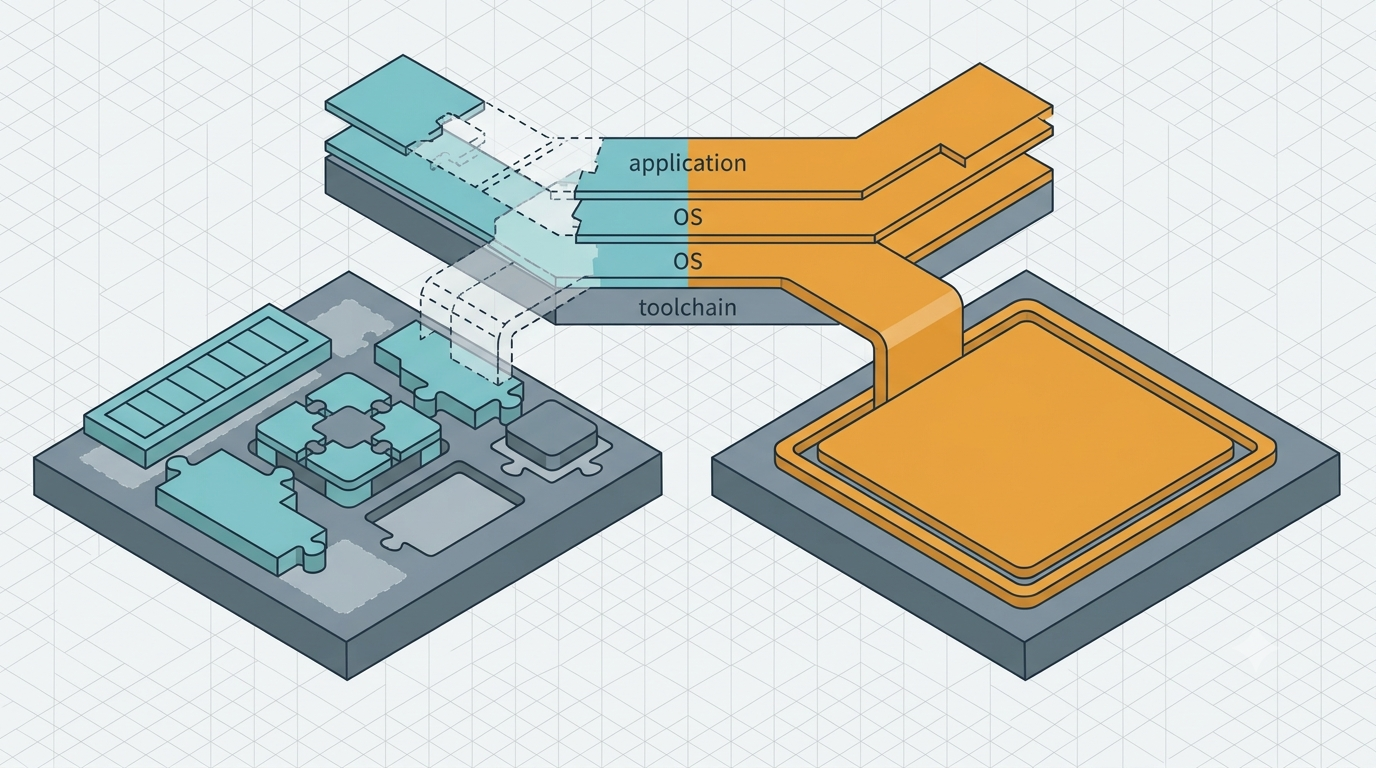
- Modularity. RISC-V defines a small mandatory base integer ISA (RV32I/RV64I) plus optional standard extensions (M for multiply, A for atomics, F/D for floating point, C for compressed, V for vector). An implementer includes only what the workload needs. ARM ships comprehensive, fixed profiles (Cortex-M, Cortex-A, Cortex-R) where the feature set is defined by the licensed core.
- Custom instructions. RISC-V reserves opcode space for vendor-defined extensions, allowing domain-specific instructions to be added without violating the spec. This is the architectural feature with the largest practical leverage for accelerator-class designs. ARM restricts this far more tightly; custom datapath extension exists (Arm Custom Instructions) but within a controlled, licensed framework.
- Profiles vs implicit compatibility. ARM's curation guarantees binary compatibility within a profile. RISC-V's openness invites fragmentation, which the profile mechanism (RVA20/22/23) addresses by fixing a mandatory extension set. The RVA23 profile standardizes which ISA features are mandatory or optional, ensuring software portability across implementations and helping prevent vendor lock-in.
Business model
This is where the decision is usually won or lost. ARM charges an upfront license fee plus per-unit royalties; in exchange you receive verified, silicon-proven IP, a mature toolchain, and a large support ecosystem. RISC-V carries no ISA royalty, but "no royalty on the ISA" is not "free silicon": you still pay for core IP (SiFive, Andes, Codasip) or you build and verify your own, and verification is the dominant hidden cost.
Strengths and weaknesses, side by side
| Dimension | RISC-V | ARM |
|---|---|---|
| ISA licensing | Open, royalty-free specification | License fee + per-unit royalty |
| Customization | Reserved opcode space for custom extensions; full freedom | Controlled (Arm Custom Instructions); curated |
| Ecosystem maturity | Rapidly maturing; gaps at the high-performance application tier | Deep, mature across MCU to server class |
| Toolchain/OS support | GCC/LLVM, Linux, FreeRTOS/Zephyr solid; commercial RTOS support uneven historically | Comprehensive, long-established, broad commercial support |
| Silicon-proven high-perf cores | Few datacenter-class options, improving | Many (Neoverse, Cortex-X) |
| Fragmentation risk | Real; mitigated by profiles (RVA23) | Low; enforced by curation |
| Supply-chain / sovereignty | No single vendor or jurisdiction controls the ISA | Single licensor, subject to export and corporate risk |
| Verification burden | Higher if self-implementing | Lower; IP arrives verified |
| Security IP | Maturing (PMP, ePMP; emerging equivalents to TrustZone) | Mature, standardized (TrustZone, PSA) |
The pattern is consistent: RISC-V's strengths are structural and economic (openness, customization, no royalty, no single point of control), while ARM's strengths are operational (maturity, verified IP, ecosystem depth, predictable compatibility). The right choice depends on which class of risk dominates the project.
When RISC-V is the rational choice for a new design
RISC-V is defensible — often clearly preferable — in these cases:
- High-volume, cost-sensitive parts where per-unit royalty dominates BOM economics. At tens of millions of units, eliminating ISA royalty is material, provided the team can absorb the IP or verification cost.
- Designs requiring custom instructions or tightly coupled accelerators. DSP kernels, crypto, AI/ML inference, or packet processing where domain-specific opcodes deliver measurable performance-per-watt gains that a fixed ISA cannot match. The RVA23 vector extension is a baseline enabler here, designed to accelerate math-intensive workloads including AI/ML, cryptography, and compression.
- Deeply embedded controllers inside a larger SoC — power management, sequencers, sensor hubs, housekeeping cores — where there is no external software ecosystem to satisfy and the core is invisible to the end user.
- Sovereignty and supply-chain-resilience requirements. Programs sensitive to export controls or single-vendor dependence. Automotive is a notable mover, with automakers — sensitive to licensing costs and supply-chain risk — increasingly preparing RISC-V-based compute platforms for systems like infotainment and ADAS.
Conversely, RISC-V is the weaker choice when you need a mature application-class core running a full Linux/Android stack today with guaranteed third-party software and middleware support, on a short schedule, with minimal verification risk. There ARM's ecosystem maturity still wins.
Is migrating existing hardware ever worth it?
For a working product, a pure ISA migration is rarely justified. The software porting cost, re-verification, re-certification (especially in automotive/medical/industrial), and ecosystem risk almost always exceed the royalty savings over the remaining product lifetime. The bottleneck in a migration is seldom the CPU core; it is the firmware, drivers, toolchain qualification, and safety case built around it.
The exception — and it is a real one — is replacing embedded "hidden" cores inside a larger chip. Many SoCs, GPUs, storage controllers, and PMICs contain small proprietary or licensed microcontrollers for housekeeping. These run vendor-controlled firmware with no external software contract, so swapping them to RISC-V removes royalty on every unit shipped without any user-visible compatibility obligation. Several large vendors have already done exactly this for in-house microcontroller blocks; NVIDIA, for instance, embeds many RISC-V management cores per GPU — on the order of tens of such cores on every GPU it ships.
The practical rule: migrate where you own the entire software stack and the core is an implementation detail; do not migrate where external software compatibility or certification artifacts are at stake.
Conclusion
RISC-V and ARM are best understood as different risk profiles rather than better-or-worse architectures. RISC-V trades ecosystem maturity and verified IP for openness, customization, no royalty, and freedom from single-vendor control. ARM trades those freedoms for predictability, depth, and lower integration risk.
For new designs, choose RISC-V when royalty economics at volume, custom instructions, deeply embedded control, or supply-chain sovereignty dominate — and stay with ARM when you need a mature application-class stack on a tight schedule with minimal verification and certification risk. For existing hardware, resist ISA migration unless you fully own the software stack and the core is an internal implementation detail, in which case replacing hidden housekeeping cores can remove royalty with negligible compatibility cost.
The development outlook is genuinely strong but uneven: standardization (RVA23) and tier-one commitment (Qualcomm/Ventana, NVIDIA/CUDA) have de-risked the architecture for embedded and AI-edge use, while the application-processor and datacenter tiers remain a work in progress bounded by silicon and software maturity rather than by the ISA itself.
References / Further Reading
- RISC-V International. (2024). RISC-V Announces Ratification of the RVA23 Profile Standard. riscv.org.
- Waterman, A., & Asanovic, K. (Eds.). The RISC-V Instruction Set Manual, Volume I: Unprivileged ISA and Volume II: Privileged Architecture. RISC-V International.
- Arm Ltd. Arm Architecture Reference Manual for A-profile architecture (DDI 0487); Arm Custom Instructions technical documentation.