Raspberry Pi in Commercial Products: Hobbyist Platform or Industrial Building Block?
Introduction
The perception of Raspberry Pi as enthusiast hardware lags well behind its commercial reality. The company's June 2024 listing on the London Stock Exchange made the underlying figures public: in 2023 industrial applications accounted for roughly 72% of all Raspberry Pi units sold, against a cumulative base of about 60 million devices shipped since 2012. The listing prospectus describes the business in terms an embedded-systems buyer would recognise — a supplier of low-cost, high-performance single-board computers (SBCs) and compute modules for industrial Internet-of-Things customers and embedded use, alongside the education market it is known for.
That gap between reputation and revenue is the practical problem for an engineer specifying hardware: the platform is routinely dismissed during architecture reviews on grounds — availability, certification, ruggedness — that apply unevenly across the product family. The relevant question is not whether a Raspberry Pi can ship in a product, but which member of the family, under which constraints, and where the line sits beyond which a purpose-built solution is mandatory.
Main content
The product family, read as an engineering taxonomy
Treating "Raspberry Pi" as one object is the first source of confusion. Three distinct tiers exist, each mapping to a different integration model:
- Single-board computers (the Raspberry Pi 4 and 5 "Model B" form factor) — a complete, fixed-layout board. Suited to appliances, gateways, kiosks, and human-machine interfaces (HMIs) where the standard board fits the enclosure and the consumer connector placement is acceptable.
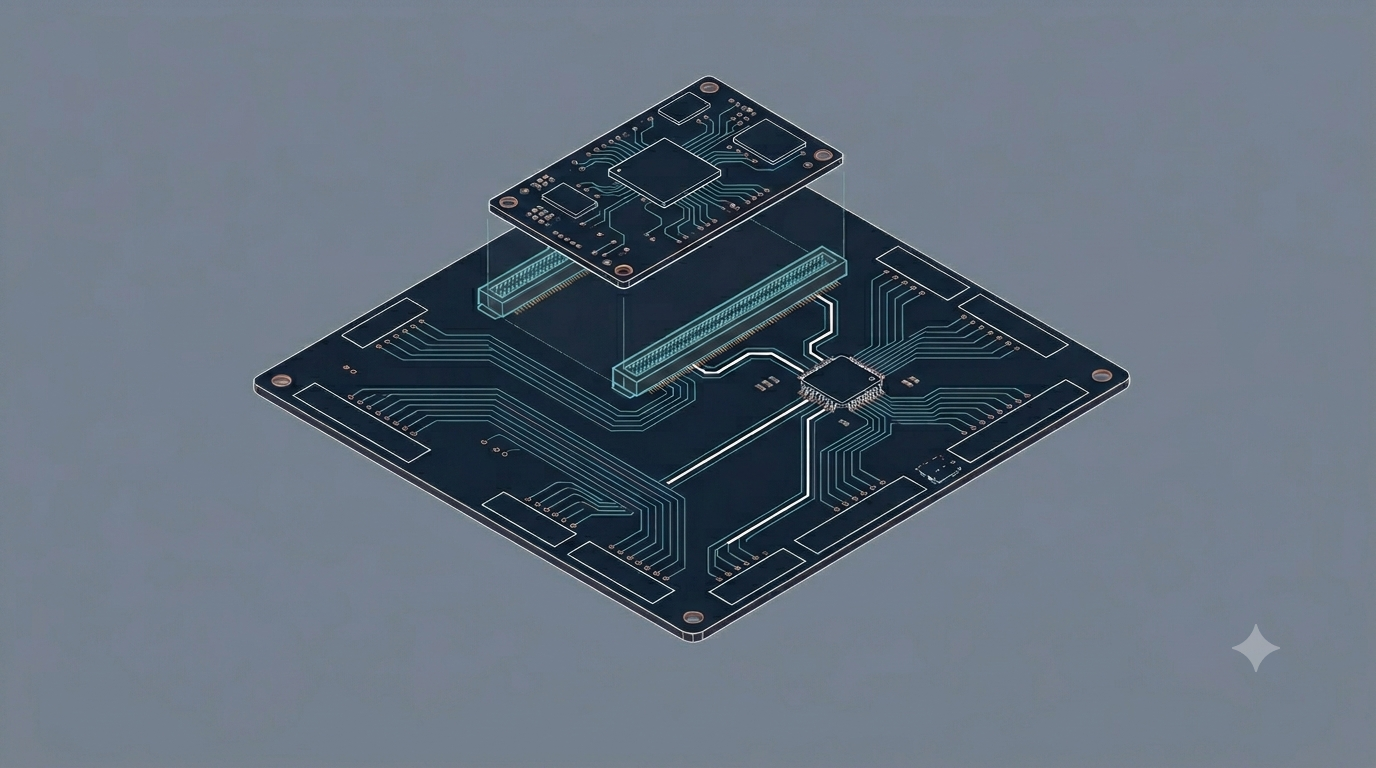
- Compute Modules (CM4) — a System on Module (SoM): the system-on-chip (SoC), RAM, optional soldered flash and a certified radio condensed onto a small board that mates to a custom carrier via two high-density connectors. This is the tier built explicitly for embedding into a product.
- Microcontrollers (the RP2040, the company's own in-house silicon, on the Pico boards) — for the deterministic, bare-metal tier where a Linux system is unnecessary or unacceptable.
For commercial product design, the Compute Module is the centre of gravity. The SBC is a finished sub-assembly; the SoM is a building block intended to disappear inside someone else's enclosure.
Why the Compute Module changed the commercial calculus
The Compute Module's value is that it absorbs the highest-risk parts of an embedded Linux design. Routing a modern SoC's DDR memory bus, sequencing its power-management IC (PMIC), and laying out controlled-impedance RF for the wireless front end are the steps most likely to require an HDI (high-density interconnect) stack-up and several board respins. The CM4 carries the Broadcom BCM2711 quad-core Cortex-A72 SoC, memory, and an optional certified 802.11/Bluetooth radio already integrated, so the carrier board reduces to power, connectors, and application I/O — frequently realisable in a far simpler, cheaper stack-up. The effect is a large reduction in non-recurring engineering (NRE) cost and schedule risk.
Two further attributes matter specifically to a manufacturer:
- Modular radio certification. The wireless CM4 variant is supplied with modular regulatory approval, which means a product built around it does not have to independently repeat Wi-Fi and Bluetooth radio certification. For a small team, avoiding a full intentional-radiator test campaign is a material saving in both cost and time-to-market. (Final-product EMC and safety certification still apply.)
- Soldered storage. CM4 variants with embedded flash (eMMC — non-removable managed NAND) eliminate the microSD card, the single most common field-failure point on consumer boards.
The breadth also supports BOM tuning: the CM4 ships in a large number of configuration options spanning RAM, on-module flash, and wireless, with pricing from roughly $41.25 per unit, so a design can be matched to its actual workload rather than over-provisioned.
The longevity question
Historically the decisive objection to using a consumer-derived board commercially was obsolescence. A product line cannot be re-spun every time a module is discontinued. Raspberry Pi addresses this directly with published end-of-production dates: the CM4 is committed to remain in production until at least January 2034, and the company states a guaranteed lifecycle of up to ten years, with continued supply negotiable beyond that for sufficient demand. The flagship SBCs carry comparable multi-year commitments. This is the structural change that moved the platform from "prototype only" to "designed-in," and it is reinforced by ecosystem support: a dedicated industry portal and an Approved Design Partners programme connecting OEMs with vetted carrier-board designers. By the same source, industrial use had already reached around 44% of annual sales as of 2021 — the trend the IPO figures later confirmed.
Where Raspberry Pi is not the right choice
The honest engineering answer includes clear exclusions. The platform is unsuitable, or requires significant compensating design, in the following cases:
- Functional safety and regulated control. The Broadcom SoC is not certified to ISO 26262 (automotive), IEC 61508 (industrial functional safety), or aerospace standards, and ships without a safety manual or documented systematic-capability evidence. Any safety-rated function must reside in separately certified hardware.
- Hard real-time determinism. A general-purpose Linux kernel is not a real-time operating system (RTOS); interrupt latency and scheduling jitter rise under load. Bounded-latency control belongs on companion silicon or an FPGA.
- Environment. Standard parts are rated -20 °C to +85 °C, with extended-temperature variants reaching -40 °C to +85 °C, but ruggedisation — conformal coating, shock/vibration qualification, wide-temperature validation across the full BOM — is the integrator's responsibility. Industrial-SBC vendors correctly note that purpose-built boards target wider temperature ranges and stricter quality-assurance and FCC/CE processes by default.
- Deep silicon customisation and supply concentration. The full SoC datasheet is not public, and the SoC is effectively single-source. The 2021–2023 allocation shortage is a recent, documented reminder that supply can tighten; the longevity pledge mitigates but does not eliminate concentration risk.
- Very high volumes. At large quantities the CM4 wins on NRE and schedule, not necessarily on marginal BOM cost, where a leaner bespoke design may be cheaper per unit.
The pragmatic pattern: Linux SoM plus companion microcontroller
Most of the objections above are resolved not by abandoning the platform but by partitioning the system. The recurring production architecture pairs a CM4 — running Linux for connectivity, the user interface, and heavy compute — with a companion microcontroller handling deterministic and safety-relevant I/O, linked over a serial bus. This hardware–software co-design keeps non-deterministic work on the SoC and time-critical work on silicon that can guarantee it.
The deployment configuration reflects that split. On a CM4 carrier, the firmware-level config.txt defines the hardware to the kernel via device-tree parameters (a structured description of on-board peripherals):
# config.txt — deployment profile for a CM4-based product
# Boot target is the on-module eMMC (soldered flash), not a microSD card

dtparam=watchdog=on    # BCM2711 hardware watchdog: lets a fielded unit self-recover from a hung kernel
dtoverlay=disable-bt   # release the Bluetooth radio, returning its UART to the header
enable_uart=1          # UART (asynchronous serial link) exposed to the companion microcontroller
dtparam=spi=on         # SPI bus (synchronous serial link) to the same MCU for deterministic I/O
The hardware watchdog above is the unglamorous feature that makes unattended commercial operation tenable: a user-space service must periodically refresh it, and any failure to do so forces a reset — turning a software hang into a brief outage rather than a site visit.
A decision framework
| Criterion | CM4-based design | Purpose-built industrial SoM | Roll-your-own SoC design |
|---|---|---|---|
| NRE and schedule risk | Low | Low–moderate | High |
| Software maturity / hiring | Very high (Debian-based) | Moderate–high | Variable |
| Guaranteed availability | To ≥ Jan 2034 (CM4) | Contractual, often 10–15 yr | Self-managed |
| Functional-safety certification | None (needs external) | Often available | Designed-in if required |
| Wide-temp / ruggedisation | Limited (extended-temp variants) | Standard | Designed-in |
| Marginal cost at high volume | Moderate | Moderate–high | Potentially lowest |
The pattern is consistent: Raspberry Pi competes on integration cost, software ecosystem, and now availability — not on industrial pedigree or safety certification.
Conclusion
Raspberry Pi is no longer only a hobbyist platform, and the 2024 financial disclosures make that quantitative rather than anecdotal: the commercial and industrial channel is the larger part of the business. For an engineer, the practical takeaways are narrow and concrete. The Compute Module — not the consumer board — is the commercial vehicle, and its case rests on three pillars: collapsed NRE and schedule risk, a mature Linux software base, and published multi-year availability. Representative shipping uses bear this out, from electric-vehicle charging stations and vending equipment to specialised medical-monitoring devices and the Revolution Pi industrial controller line built on the module.
The platform is appropriate when the product needs an embedded Linux computer with connectivity, a graphical interface, or moderate compute, in benign-to-moderate environments, at low-to-medium volume, with safety- and time-critical functions delegated to companion hardware. It is the wrong choice when the design demands certified functional safety, hard real-time control on the main processor, full industrial-temperature and ruggedisation guarantees out of the box, or the lowest possible per-unit cost at very high volume. Between those poles, the CM4-plus-companion-MCU architecture is a defensible, mainstream commercial design — which is precisely why so much of the company's output now ends up inside other companies' products.
References / further reading
- Raspberry Pi Ltd, "Compute Module 4," product page and datasheet (specifications, configuration options, production-to-2034 commitment, temperature ranges). https://www.raspberrypi.com/products/compute-module-4/
- Raspberry Pi Ltd, "Supporting Raspberry Pi's industrial customers" (Approved Design Partners programme; industrial share of sales). https://www.raspberrypi.com/news/supporting-raspberry-pis-industrial-customers/
- Raspberry Pi Ltd, "Raspberry Pi IPO" announcement, 11 June 2024 (London Stock Exchange listing as Raspberry Pi Holdings plc). https://www.raspberrypi.com/news/raspberry-pi-ipo/
- Raspberry Pi Ltd / London Stock Exchange, Intention-to-Float and Registration Document, May–June 2024 (2023 unit-mix figures, OEM customer base, channel strategy).
- Raspberry Pi Ltd, "New memory variants for the Raspberry Pi Compute Module family," April 2024 (industrial use cases; Compute Module 4S availability and pricing). https://www.raspberrypi.com/news/new-memory-variants-for-the-raspberry-pi-compute-module-family/