The Rise of Open LLMs: The Llama Line and the Ecosystem It Built
Introduction
Not long ago, the capable language models that mattered were closed: accessible through APIs, with undisclosed weights, architectures, and training data. The open alternatives lagged by a wide margin in quality. The release — and subsequent leak — of Meta's first LLaMA models changed the trajectory of the field, not because the weights were perfectly open (they were not), but because they were good enough that a research and engineering community formed around them within weeks.
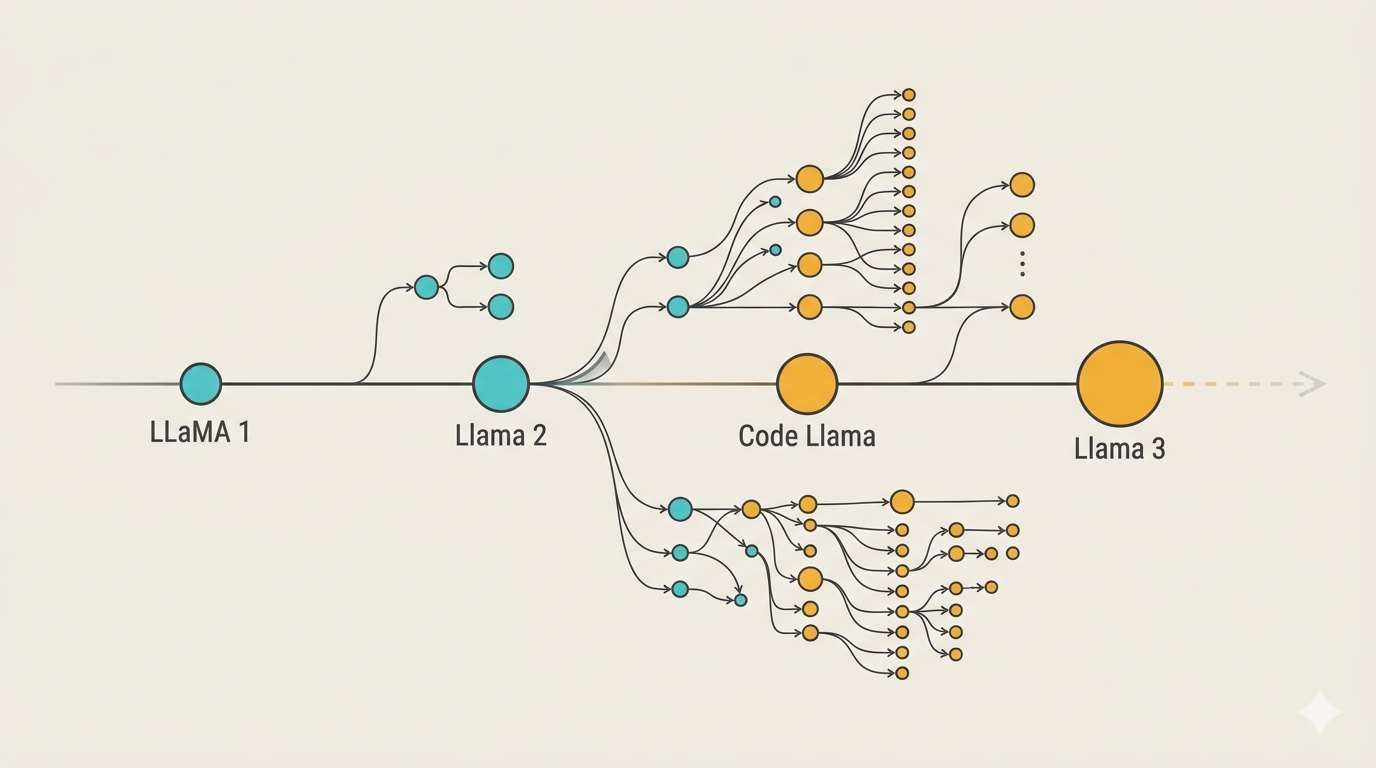
For an engineer evaluating whether to build on open models, the relevant history is not a list of model names but a sequence of concrete technical decisions: how training compute was allocated, what the license actually permitted, how alignment was performed, and what tooling made local inference feasible. The Llama line is the cleanest case study because each generation made deliberate, documented changes, and because the surrounding ecosystem — Alpaca, llama.cpp, QLoRA, Mistral, and others — formed largely in response to it.
LLaMA 1: the compute-optimal seed (February 2023)
LLaMA 1 shipped in four sizes — 7B, 13B, 33B, and 65B — trained exclusively on publicly available data (Common Crawl, C4, GitHub, Wikipedia, books, ArXiv, Stack Exchange). Its central design choice followed and then sharpened the Chinchilla scaling insight: rather than maximizing parameters, Meta trained relatively small models on far more tokens than compute-optimality alone would dictate (roughly 1.0–1.4 trillion tokens), trading training cost for cheaper inference. The result was that the 13B model outperformed GPT-3 (175B) on most benchmarks, and the 65B was competitive with much larger contemporaries.
Two facts about LLaMA 1 shaped everything after it. First, it was released under a non-commercial research license, with weights gated by request — and the weights leaked publicly within weeks. Second, the architecture was a clean, conventional decoder-only transformer with pre-normalization (RMSNorm), SwiGLU activations, and rotary position embeddings (RoPE), with a 2048-token context. This combination — strong quality, accessible weights, and an unremarkable architecture that was easy to reimplement — made it the obvious base for experimentation.
The ecosystem response was immediate. Stanford's Alpaca fine-tuned the 7B model on 52K instruction-following examples generated by an existing model, for a few hundred dollars, demonstrating that instruction tuning was cheap. Vicuna applied the same idea to conversational data. Georgi Gerganov's llama.cpp brought quantized CPU inference to laptops and made the models runnable without datacenter GPUs. QLoRA then showed that a 65B model could be fine-tuned on a single 48 GB GPU by combining 4-bit quantization with low-rank adapters. Within a quarter, the cost of both running and customizing a capable model had collapsed.
Llama 2: the commercial inflection (July 2023)
Llama 2 was the release that mattered commercially. Sizes were 7B, 13B, and 70B (a 34B model was trained but withheld, with Meta citing insufficient red-teaming results). Training data doubled to roughly 2 trillion tokens, context length doubled to 4096, and the 70B model adopted grouped-query attention (GQA) to reduce inference memory bandwidth. Meta also shipped aligned Llama 2-Chat variants tuned with supervised fine-tuning followed by RLHF, using rejection sampling and PPO, and introduced techniques such as Ghost Attention to maintain instruction adherence across turns.
The decisive change was the license. The Llama 2 Community License permitted commercial use, with the notable exception of services exceeding 700 million monthly active users. This is not an OSI-approved open-source license — it carries field-of-use restrictions and an acceptable-use policy — so the accurate term is open-weight rather than open-source. That distinction became a recurring point of contention, but in practice the license was permissive enough that companies began deploying Llama 2 in products, and the model became the default base for downstream fine-tunes. Code Llama extended Llama 2 for programming, adding infilling, much longer effective context, and a 70B variant early the following year.
The ecosystem diverges
Through this period the open field stopped being Llama-only. Mistral 7B, released under Apache 2.0, matched or exceeded Llama 2 13B while being smaller, using sliding-window attention and GQA. Mixtral 8x7B introduced a sparse mixture-of-experts (MoE) design — activating only a fraction of parameters per token — that reached Llama 2 70B quality at a fraction of the inference cost, also under Apache 2.0. Architecturally and legally, these models pushed the frontier of what "open" could mean.
Tooling matured in parallel. Direct Preference Optimization (DPO) offered a simpler alternative to full RLHF pipelines. The GGUF format standardized quantized model distribution; AWQ and other schemes refined accuracy-versus-size trade-offs. Inference servers such as vLLM (with PagedAttention) and Text Generation Inference, together with FlashAttention-2, made high-throughput serving practical. The open landscape broadened further with Google's Gemma, Databricks' DBRX MoE, Cohere's Command R+, Alibaba's Qwen 1.5, and Mixtral 8x22B.
Llama 3: scaling data and the tokenizer (April 2024)
Llama 3 launched 8B and 70B models, with a 400B-plus model disclosed as still in training. Its headline change was data scale: over 15 trillion training tokens, roughly seven times Llama 2's corpus, with substantially more code. The tokenizer was replaced with a 128K-vocabulary BPE implementation that encoded text more efficiently, improving effective throughput. GQA was applied across both sizes, context was 8192, and the models were trained on two 24K-GPU clusters. The practical outcome was striking: Llama 3 8B outperformed Llama 2 70B on many benchmarks, confirming that data quantity and quality, not parameter count, were the dominant levers at this scale.
| Generation | Date | Sizes | Train tokens | Context | Notable |
|---|---|---|---|---|---|
| LLaMA 1 | Feb 2023 | 7/13/33/65B | ~1.0–1.4T | 2048 | Research license; weights leaked |
| Llama 2 | Jul 2023 | 7/13/70B | ~2T | 4096 | Commercial-permissive license; RLHF chat; GQA on 70B |
| Code Llama | Aug 2023 | 7/13/34/70B | — | up to ~16K+ | Code specialization; infilling |
| Llama 3 | Apr 2024 | 8/70B (+400B training) | 15T+ | 8192 | 128K-vocab tokenizer; GQA on all sizes |
Conclusion
The open-weight field now has a clear shape. Meta's Llama line supplies the dominant general-purpose bases; Mistral and others have demonstrated that MoE architectures and Apache-licensed weights can lead on efficiency and openness; and a deep tooling stack — quantization formats, parameter-efficient fine-tuning, and optimized inference servers — means that adapting and deploying a model no longer requires frontier-scale infrastructure.
For an engineer, the practical takeaways are concrete. Open-weight models are appropriate when data residency, cost control, customization via fine-tuning, or on-premises deployment matter, and when the workload tolerates a capability gap to the closed frontier. They are a weaker fit when the absolute strongest reasoning is required, when the licensing terms conflict with the deployment (the Llama license is not unrestricted open source, and "open weights" should never be assumed to mean OSI-open without checking), or when the team lacks the operational capacity to serve and maintain the model. The decision is increasingly about license, serving cost, and customization needs rather than raw quality alone — a reversal from the situation only fifteen months earlier.
Speculation: where open LLMs go next
The following is forecast rather than fact — a projection from where the field currently stands.
The most direct prediction concerns Meta's still-training 400B-class Llama 3 model: once released, it is likely to be the first open-weight model to credibly contend with the strongest closed frontier systems, narrowing the open-to-closed gap to something on the order of months rather than a generation. Meta's own messaging points toward future releases adding multimodality, longer context windows, and broader multilingual coverage, so the reasonable expectation is that open models follow closed ones into vision and audio inputs, and that today's 8K context is a transitional figure soon extended through RoPE-scaling and architectural change.
On architecture, the Mixtral–DBRX–Arctic trajectory suggests sparse mixture-of-experts becomes the default approach for pushing capability while controlling inference cost, with dense models persisting mainly at the small end. That small end looks important: the Phi line and similar efforts indicate that carefully curated and synthetic data can make compact models punch far above their parameter count, which points toward capable on-device and edge deployment. Synthetic data generation and distillation from stronger models seem likely to become central to training pipelines, and simpler alignment methods such as DPO appear poised to displace heavier RLHF stacks in most open work.
Two non-technical forces look decisive. First, the open-weight-versus-open-source tension will sharpen: as models approach frontier capability, scrutiny of restrictive licenses and acceptable-use policies will grow, and regulatory attention — the recently adopted EU AI Act, and existing US executive action — will increasingly focus on the specific question of releasing powerful model weights openly. Second, the base-model supply looks set to consolidate around a handful of well-capitalized providers (Meta, Mistral, Alibaba, Google) feeding an enormous, decentralized fine-tuning and tooling community downstream. The plausible failure modes for this forecast are a regulatory clamp on open weight releases, or a training-cost escalation that prices all but the largest players out of producing competitive bases. The optimistic version is the modal case, not a certainty.
References / Further Reading
[1] H. Touvron, T. Lavril, G. Izacard, et al., "LLaMA: Open and Efficient Foundation Language Models," arXiv:2302.13971, Feb. 2023.
[2] H. Touvron, L. Martin, K. Stone, et al., "Llama 2: Open Foundation and Fine-Tuned Chat Models," arXiv:2307.09288, Jul. 2023.
[3] B. Rozière, J. Gehring, F. Gloeckle, et al., "Code Llama: Open Foundation Models for Code," arXiv:2308.12950, Aug. 2023.
[4] Meta AI, "Introducing Meta Llama 3: The most capable openly available LLM to date," Meta AI Blog, Apr. 2024.
[5] A. Q. Jiang, A. Sablayrolles, A. Roux, et al., "Mixtral of Experts," arXiv:2401.04088, Jan. 2024.
[6] T. Dettmers, A. Pagnoni, A. Holtzman, L. Zettlemoyer, "QLoRA: Efficient Finetuning of Quantized LLMs," arXiv:2305.14314, May 2023.